“Place and mind may interpenetrate till the nature of both is altered. I cannot tell what this movement is except by recounting it.” (Nan Shepherd, The Living Mountain).
Every year great shearwaters circle the Atlantic like an ocean current.
When the temperature on Tristan da Cunha — the remotest permanently settled
island in the world — dips in autumn, they head to the Atlantic coast of South
America, turn north, cross the doldrums and keep on heading north until they
reach the north-east tip of North America. As the northern summer turns, they
circle across, passing Britain on their way down the eastern Atlantic, back to
find spring on a wet speck of rock in the south Atlantic. Stop. Breed. Repeat.
I was last amongst them in 2014. Not on land but in a RIB — a boat
that’s several feet too small in every direction to be comfortable — floating
for 30 hours, five miles out in the Atlantic. Several thousand miles in front
of me was the American coast: behind me the jagged peaks of Madeira, the tips
hiding in clouds of their own making. Around me, great and Cory’s shearwaters
sat on the sea, waiting. The birder term for it is rafting — when they look
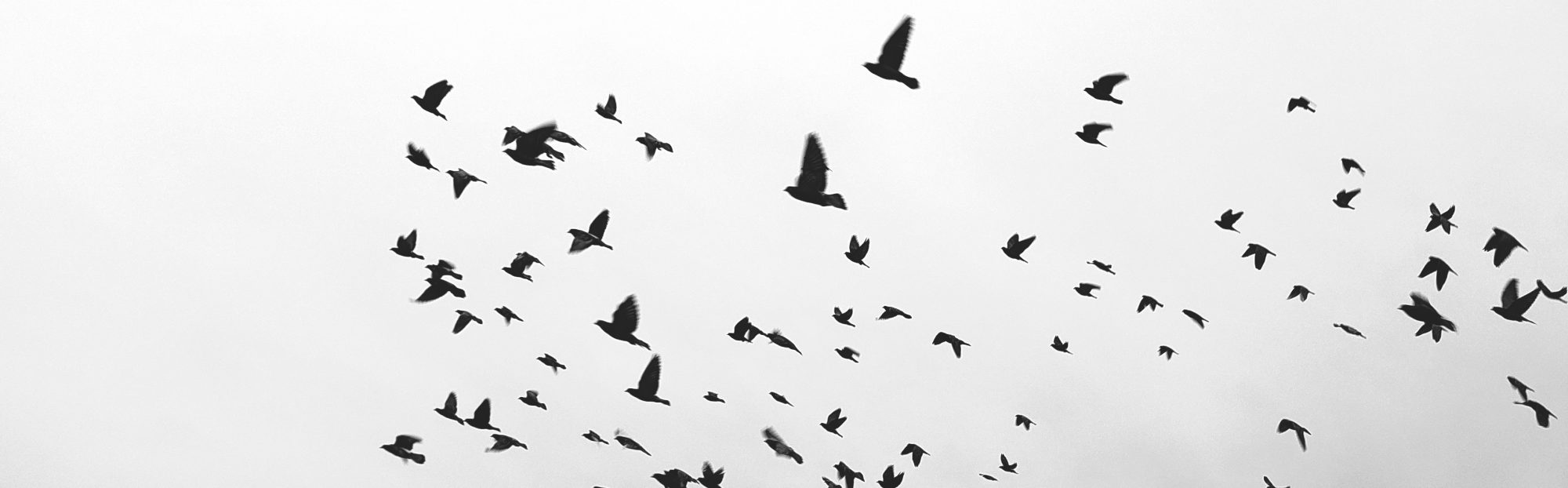
like oversize ducks on the biggest of ponds. They took off, unfurling their
wings, slapping feet on sea, and transformed. Their wings are long, thin and
stiff. With them they catch the breeze like sails, and skim across the tops of
waves. A stray wave, something irregular could wash them away, yet it never
seems to happen.
The meaning of trip’s experiences are still slowly unfurling, like a
shearwater’s wings, over time.
***
Pterodroma petrels are
birds of myth and mystery: what is not known about them vastly outstrips what
is. The English name for the family is the “gadfly” petrels, which my
dictionary says means “a person who annoys”. Though flippantly truthful, I
prefer Pterodroma: ancient Greek for “winged runner”. Both capture the
essence of the family, fleeting, elusive, frustrating.
Fea’s petrels were discovered in 1899 by Leonardo Fea. Not long
afterwards, Zino’s petrel was first found — unknowingly — by Ernest Schulz. It
wasn’t until the 1960s that Paul and Frank Zino rediscovered them breeding on
the third highest of the Madeiran peaks, the Pico do Arieiro, where their
mournful wailing haunts the high peaks. They sing slightly differently to the
Fea’s which breed on the Desertas Islands and Cape Verde*. Both species are
rare: there are over a thousand individual Fea’s petrels. There are somewhere
between 100-200 Zino’s petrels depending on how successful the breeding season
is, and where the wild fires that strike Madeira burn. In 2010 only one chick
survived: thirty-eight others and four adults were burnt alive.
I saw my first Fea’s distantly, briefly, underwhelmingly. It was an
encounter loaded with an excitement that the sighting — fleeting, distant,
disappearing in the gaps between waves — couldn’t satisfy. Like meeting a
childhood hero. The second, several hours later, was better.
Seabirds harness the wind to fly. Shearwaters sail elegantly, slowly. Pterodromas
spiral up, hit their apex, dip a wing and shoot seawards at a shallow angle,
like following waves through the air. We saw this Fea’s coming from far off, stitching
sea to sky. It is a fast flight. Deceptively so. In seconds it was beside us,
arcing up, wings flexed forward. Dove-grey back and a fainter black line,
zigzagging down the wings. Its tail is paler — the bird fading out. It’s head
darker — black-eyed, black blunt bill. It dipped its wing and vanished.
I have a video of that encounter: ten seconds of meeting a mythical
seabird. It still sends bolts of excitement through my nervous system.
It wasn’t until the second afternoon at sea that Catarina, behind the
boat’s engines, spotted a Zino’s. She shouted: all idle chat stopped. A boat
full of binoculars all drawn to one bird. It is essentially identical to a
Fea’s. It swung up, reached its apex, and sheered down alongside the boat. It
took all I could remember and all I could see to note the differences. The
whiter underwing, the thin black bar running up it. The smaller, lighter size,
the bill not so brutishly big, the flight that feels slower. It sheered behind
the boat, between us and the high Picos of Madeira, before flying away over the
waves. We all watched it until it disappeared over the edge. And as it
disappeared the feeling was part relief — the trip a success, the birds still
in existence — and part awe that they exist at all.
Yet. As I look back on it now it all seems tainted with metrics. It is
not because of their essential similarity to the Fea’s petrel — the two species
have a very different essences — but because rarity is a fact that conquers
all. Fea’s may thrill but the experience of a Zino’s is difficult to separate
out from their sheer vulnerability of their numbers.
***
The third day at sea. Both Pterodromas encountered, we sailed to
a different spot. This time in the shadow of the Desertas Islands: two great
lumps of abandoned rock that intervene into the sea’s horizon. We sailed out
there with a super pod of more than 100 Atlantic spotted dolphins bow-riding,
accompanying the boat down the coast of Madeira. A flying fish leapt in front
of the boat, wings shining blue-green, tail-slapping the water as it went, as
though it had evolved legs as well as wings and could never decide which it
would rather use.
The day was hot and long. Birds were scarce but for the Bulwer’s petrels
— bat-like in flight, impossibly slender, and much smaller than they look in
the book — that were regularly flying laps around the boat. But it didn’t need
to be a productive day. It felt valedictory: like we were content (smug) enough
with what we had seen. Maybe it was the heat but I realised then that what I’d
miss most from this was a three-quarter horizon of sea, rolling away until the
edge of vision, essentially to infinity. A horizon of freedom, no obstacles and
nothing hemming in. I felt then the urge coming over me that nothing would give
me greater pleasure than to dive headlong over it; to be a great shearwater,
always heading over endless empty horizons.
I resisted. If only because I can’t swim.
***
We stayed out until sundown. Behind the Desertas we were unaware that a
fierce breeze had sprung up. We headed directly into it.
Waves thump into the boat and the spray breaks over us. Lips burn, eyes
sting. The rolling crests of grey waves turn peach in the light. There is
another type of wave: one we don’t crash over, but one we pitch into and skid
over, with a momentary feeling of helplessness. A feeling of being suddenly at
the mercy of the sea. The sun sets completely. Night unfurls. The boat has a
tiny light, enough to make out the edges but not quite enough to see the next
wave until it hits and I have to spit out a mouthful of seawater. I begin to
notice other lights. Either side. Trawlers and small fisherman and buoys. The
spray of a vicious wave. The lighthouse on the edge of the island. A plane’s
headlights breaking through the night. A galaxy of streetlights strung out from
Funchal to Canical, along the populated coast. The football stadium and the
fish factories. The harbours and bars. The plane landing at Funchal
international airport. I take my hat off and lean back and a voice whispers in
my ear of the plough and other constellations. I see Madeira reflected in the
sky. An unfathomable sky of distant stars and the smudge of Milky Way. I don’t
want explanations. A dolphin breaches as we enter the harbour. A Cory’s
shearwater circles under streetlights, calling, louder than the throb of
distant parties. Spontaneous applause. Handshakes and smiles.
*A
note about taxonomy. The Fea’s petrels of Cape Verde are the original Pterodroma
feae. Those breeding on the Desertas Islands are thought by some
to be a third species, Pterodroma desertas. Desertas differs only from feae
in the measurements of its bill length and depth, tarsus, and, marginally, in
the length of their wings. If desertas is proven to be a separate species, its
population of 150 breeding pairs makes it eye-wateringly rare (and yet twice as
common as Zino’s).


 Stephen Rutt