In the moment it doesn’t seem real: June’s low-hanging moon, slowly rising behind the trees, a vast sphere glowing peach like an ironic sun. It ascends slowly to sit behind a faint smudge of cloud. Light has been dimming by degrees all dusk, while we have been stood by the bog; watching as white stars of cuckoo spit and constellations of cotton grass disappeared into dark shadows, and noctule bats flew fast and straight along the edge of the pines behind us like a wall of death: death for the pale moths that flickered up from the heather. Pipistrelles flew wildly, a controlled chaos where the eye just sees the chaos and not the control, the wings not visible against the dark pines as if they were optional. Midges danced around my eyes.
In the incremental darkness the bats dwindle, rising high into the light we can’t see.
And that’s when the nightjars start singing. It is one of the hardest sounds to describe. Nothing ever catches it. It starts half as a hum and half as a purr. A sort of background sound that lacks definition until one comes close and – well Baker had it as the sound of wine being poured into a cask and that’s not it; though it is heady as red and flowing catches something of it – the song spreads warmly through the dusk. If being hypnotised had a sound it would be this. Compelling yet diffuse. Strange yet relaxed.
The nightjars come in the last of the light. Overhead, high by the pines behind, flying on flat, paper plane wings until they flap, stiffly. A pair swing around in front, clipping the seam of the dark horizon, pulling up into the last of the light in the sky. Against the sky they resemble a pared down kestrel – same rough shape but reduced to the essentials, as if just bone and feather magicked to life. They dart into the pine, slipping between the black branches. Periodically they settle, perching, disappearing black on black, but for the big-headed outline. The pair come and go. Flitting until the light dissolves to dark.
The bog reclaimed by night. Their song stops suddenly, as if halted by the love-lament of a tawny owl. And nothing of the night feels real. Too good to be true. But it happened. As we leave, all that remains to be seen: that low-hanging peach of a full moon.
The end-of-winter grasses have been stroked flat by the salt-winds and bleached by the extremes of the season. They have taken on a russet-tone in the light, like the pelt of a red deer or dead bracken or a distant planet; the last ebb of winter before green begins to spread through the marsh again, each little plant that makes up this vast expanse turning green in the light of new life.
But I’m getting ahead of myself.
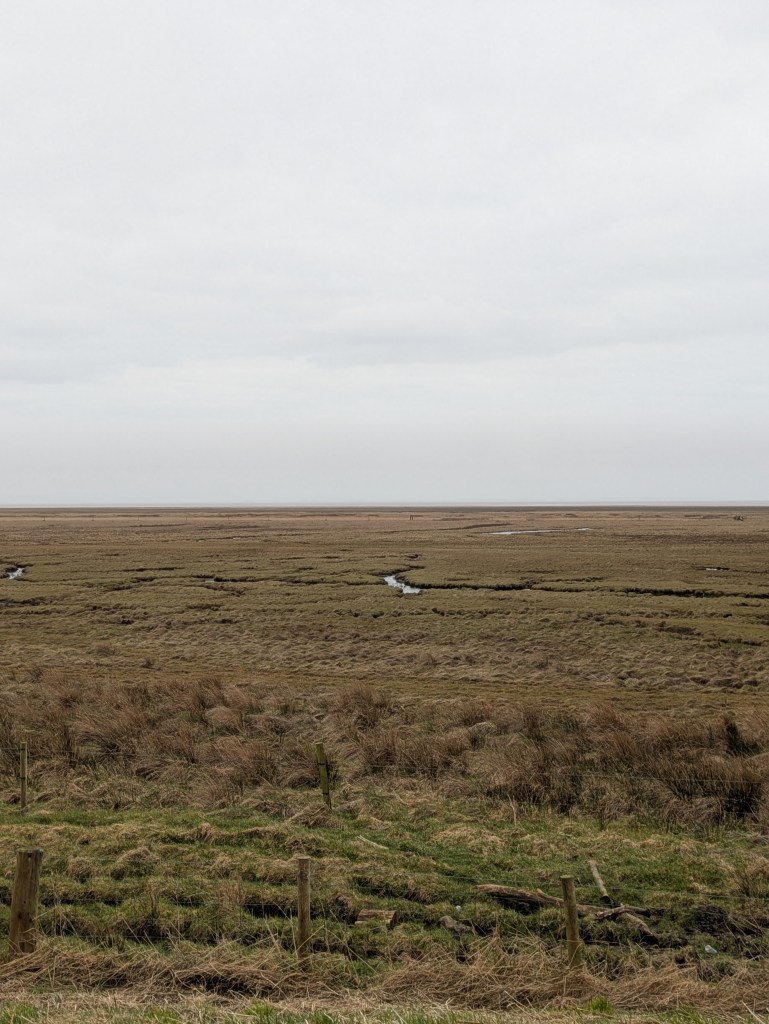
Today is old life, not new life. The wind cuts in through the window, chilling the concrete walls of the hide like it is still December. The wind does not budge the shroud of low white cloud that has hung over Dumfries and Galloway for what feels like five months now. It seals off the horizon, cutting the merse off from all but a few metres of the lapping sea, as the tide slowly takes back the land from where the water wants to be. This is a place, in this mood, that is completely context free. A little egret by the silver crook of a creek looks as tall as a great. A skein of barnacle geese drift in, parachuting to the ground on out-stretched wings, and land as small as rabbits.
And then the hen harrier. It just appears, silver, as if the sky has shed a flake of itself that flaps powerfully, the fastest thing in the still landscape. It skims the grasses. In the hide I sit unseen while it flies, trying to be unseen, Juncus-height from the ground, around the back of the gorse bushes, narrowly clearing the five-bar gate. It disappears behind the old salt mounds. Then reappears minutes later as a phantom – a felt threat, a frantic panic from a few hundred geese getting up in a clatter of wings and a swirl of golden plovers.
Soon it’ll be dancing in the skies, thrilling the hillsides where we let them, if it ends up out of persecution’s reach.
But I am getting ahead of myself.
The tide swallows another chunk of the merse. Time passes, slowly.
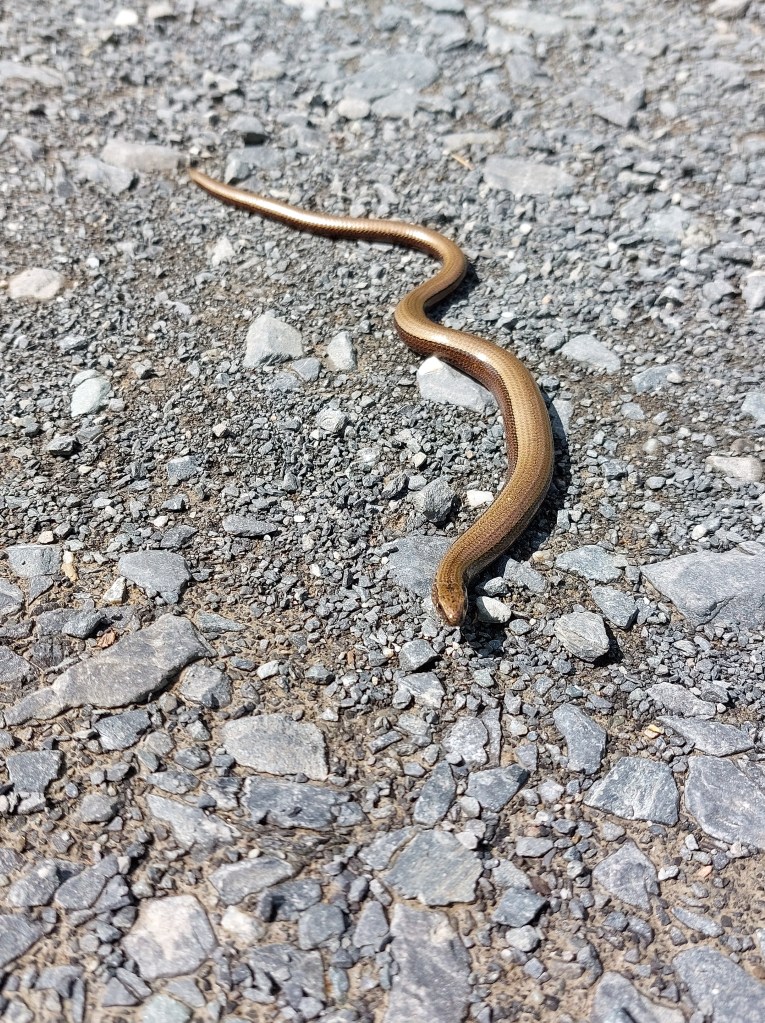
I was not paying attention. I was elsewhere. Deep in my head and thinking of how the bracken has grown so high over the month and a half since my last visit, and how it was that the pearl-bordered fritillaries were skimming the ground then, whereas the later small pearls are raised a little higher; and now the dark green fritillaries of June after the solstice fly metres up over the dense greenery, faster than I struggle up the slope that never used to be this steep until my snack count caught up with my step count and how redstarts do not cross my path the way they haven’t crossed my path all year and this year is racing on and am I being a good parent to take this afternoon off alone and oh damn –
I take evasive action. Throw myself forward and stumble just beyond, the wavering bronze body zigzagging across the path like a broken bracken stem. The slow worm turns to look at me, the way you’d glare at a bad driver. I crouch down. Whisper an apology. Take its picture as it slithers to safety.
The picture is a reminder.
I haven’t been out much recently because responsibility turns you into an accountant of time. On the balance sheet of life, being outside is a luxury that I can’t always afford. When I do get outside I feel a pressure to make it profitable, to apply my knowledge to a place and search for what I think I should find, instead of letting it come to me; of thinking the big thoughts instead of being present. It’s hard to remember that all that is required is to look where you are going and hang your head like a penitent.
It works. I swap track for boardwalk. Tadpoles form a thick soup in the shallow edges of the water. An orchid has risen from the bog like a firework frozen in time. Lizards skitter – blue and green, one thick and sluggish (pregnant, I presume) – scales glittering in the sunlight, down the edges of the boards.
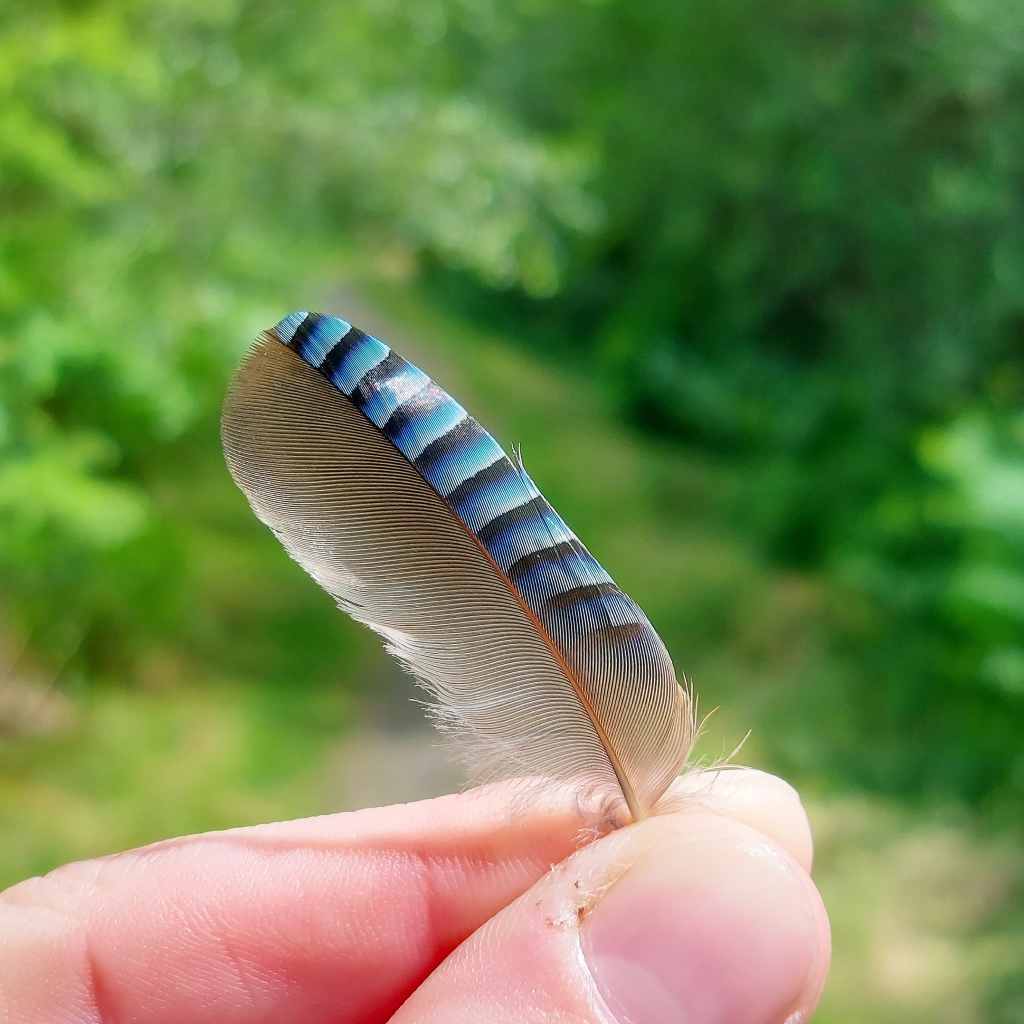
I swap boardwalk for forest path. And something else glitters in the sunlight. A feather. Split down the shaft, the left side a mucky grey-brown, fading at the worn tip. The right side is a series of black lines bleeding colour, an auroral shimmer of blues into white. A jay has passed this way, shedding one of its coverts. I pick it up. In the sunlight, it looks like the most beautiful thing I’ve ever seen, a thing unpredicted, found by letting my eyes just run across the path with no set ideas.
It moves like a spark at first. A flash, disappearing, as if cast up from the stones underfoot. The fourth spark catches on the dead bracken by the trackside, pausing, growing wings, burning orange, shivering with movement, its thick body flexing. Off – past the bluebell to the bugle. Descending to the blue and purple spike. Off – restless, fidgeting from flower to flight.
If spring is a series of shocks – Light! Warmth! Swallows! – then nothing quite hits the way that colour does. Above, the bright leaves of new beech, trembling with chlorophyll, filter the light. Welsh poppy stands like a lightbulb by the path, growing opposite the white-spangled stitchwort and ramsons that bracket the dull shimmer of bluebells. Water avens hangs its head as if in shame. Green tiger beetles scuttle over stone. Colt’s-foot breaks through the track, the sun seen through a periscope, next to the shaggy heads of dandelions. It’s on a dandelion I see it better. The pearl-bordered fritillary perches, its wings of amber and black fretwork absorbing the meagre sunshine. Meagre but enough. Both butterfly and flower glow.
This wasn’t the given it might have appeared to be on paper. Flight periods are a vague suggestion, prone to individual variation; variation in region; variation in weather. This disordered spring: chiffchaff and willow warbler early. Sand martins only a day before house martin; over a fortnight before swallow. Bud and bloom side by side. March warm and April cold and May wet. Prediction is increasingly futile. Half the wood’s birds are back, the rest missing, status unknown.
Winter lingers in the rust of dead bracken. The oak leaves still unfurling like a hand held half-beckoning.
A passing walker asks what I’m looking at.
‘Pearl-bordered fritillary’, I say, ‘one of Scotland’s rarest butterflies.’
She nods wisely. ‘We are lucky to have such things’.
You fooled me for that first instant, curled up in the same tussock of reeds as the otter had, three weeks ago. But your size gives your identity away, between stoat and otter, similar to the cat curled up on the sofa at home. After your size, your shade: sandy, paler than expected, as if the strong sunshine this afternoon has bleached you like the dead grasses the river has strewn across your tussock. You don’t care about any of this, or us, stood a few metres away, almost directly above you by the wall that separates roadside from riverbank. You’re only bothered by the kayaker paddling in the middle of the river, raising your head over the tussock to see, watching and waiting for the kayak to turn towards you and –
Off. The mink shoots through the water between the tussock and the wall, below the algae and floating plastic bottles, hidden by the over-hanging greenery growing from the cracks in the sandstone.
A pause. I assume it has absconded, performed the sudden silent vanishing act of which all animals are capable. But then it bursts up through the greenery, vanishing into a hole in the wall below our feet.
A few seconds later a head, neck and shoulders emerge.
It is now at its least otter-like. The head is triangular, topped by a pair of rugby-players ears, tapering to a fine button snout, not the broad-jawed, luxuriously-whiskered face of an otter. Its two shining round black eyes are ringed with paler markings, which are also smudged around its snout. The fur should be uniformly dark brown, but this a genetic throwback; a clue to its origins as an animal bred for fur, its pelage valuable, skin fashionable, bred by degrees away from the norm. I reach for new comparisons: cat, stoat, red panda, each one slightly more ridiculous than the last. Then it vanishes, dives into the water, swimming away with a jerky front crawl, each limb paddling, working the water, as awkward as I would be.
It is electrifying. The combination of the surprise encounter, the view close enough to see its nose sniffing the air, its body thrumming with breath, its lack of fear of us. The encounter has all the wild magic of any with a muscular mustelid, that fleetingness, as if it is up to them whether they grace your day with their presence. The sliding-doors timing: if not now, then perhaps not for another few years.
And yet this is tempered. Nuance descends.
I’m not supposed to like mink. The wild qualities I see in the animal are not the wild qualities of the River Nith. Ecologically speaking they are a murderous square peg in the round hole of the British ecosystem. The rap sheet reads: destroyer of the water vole, the salmon-run, and the ground nesting birds on the river’s gravel islands (or, potentially, with their wall-climbing skills, the sand martins that exploit old pipes in the built sandstone banks). The local Facebook group of wildlife enthusiasts dissolves into vitriol and invective whenever a picture of a mink is posted without an outraged caption. But nuance works both ways. They belong in American ecosystems, not ours: it is not their fault that they were put here by the forces of farming and money-making that we wrought across the world, when we spread British species across the globe with similar effects as this mink.
It is hypothesised that the resurgence of otters in British rivers is having a negative effect on the mink, that otters out compete mink for food and territory. Yet here was one basking on the same tussock on which I saw an otter spend an hour eating a lamprey a handful of weeks ago. This is not evidence to disprove that theory, of course. It’s not evidence of anything at all other than existence. It is just an observation that further heightens the division in my mind: that I can be thrilled by the encounter, and at the same afraid of what it means.
I took it as evidence of a peregrine’s presence. Fresh evidence. The redshank’s head resting in the strandline, nestled between seaweed and sea-washed grasses and shingle. Its body was nowhere to be found below the delicate pink of its viscera, spilling out just below the line between the throat and the nape. Its slight, half-orange, half-black beak still open, as if stopped mid-sentence.
Like that line of Housman’s that has been orbiting my brain in these early spring days, after March’s burst of summer, and April’s reversion to frost. We had drifted east along the coast, our first destination hailed off in a storm of pea-sized chunks of ice, the temperature plummeting, the sand martins circling ever-lower over the water in search of the insects, everything stunned into dormancy, silence or shelter.
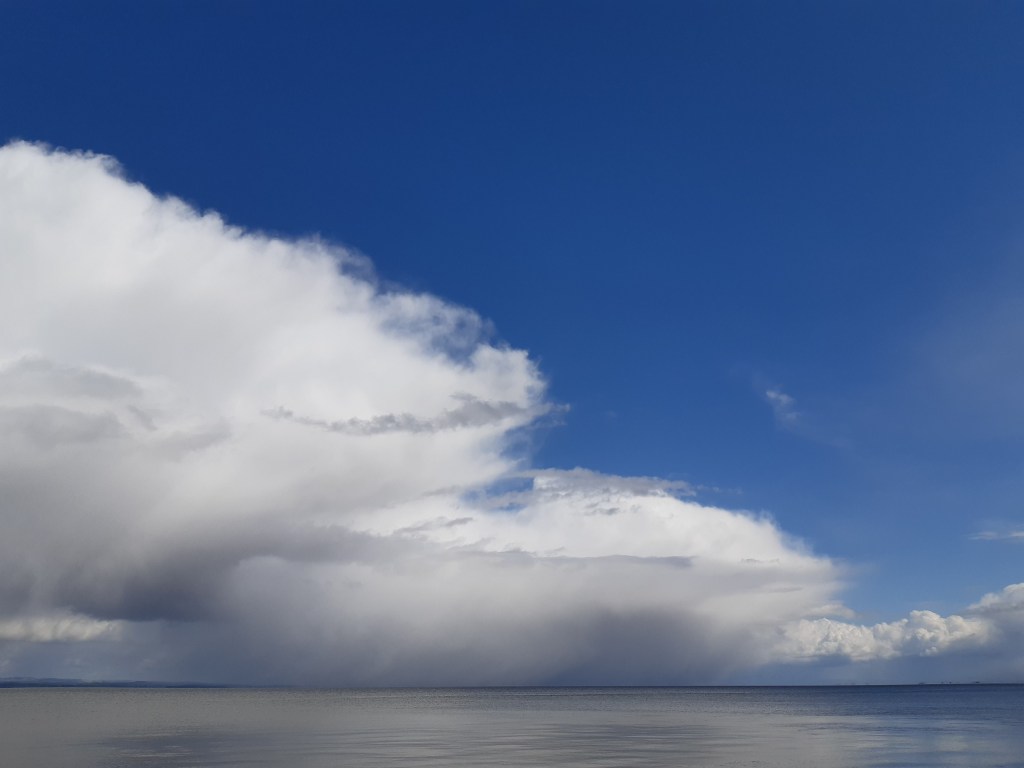
After the hail, thick white flakes of snow were slowly falling from a flat grey sky that hung low, stifling the light. We drove out of it, to the other side of the headland, to a deep blue break in the weather, surrounded east and west by thick clouds, simultaneously fluffy and monolithic. The firth had just peaked at high tide, the time when the water appears to have paused, its energy spent, the waves now mere ripples lapping at the shingle. The Solway seems to shine at times like this: a mix of green and blue and grey, with a string of shelducks in the bay, and four red-breasted mergansers, smaller, not quite as white in the sun, patterned with the same rippling lines as the water.
The air is cold, growing colder here too. Along the shoreline, redshanks walk between the rocks and the water, jerky-limbed, calling as if nervous, as if in reassurance to each other, that what has happened has happened, is past not present. And at my feet the severed redshank head says: that springs can be long and slow and cold, but that new life inevitably takes over from old.
It feels like only recently my April events were being cancelled. It feels like a lifetime ago that I sat down in the spare room to record the readings I would have given anyway for people who would have attended.
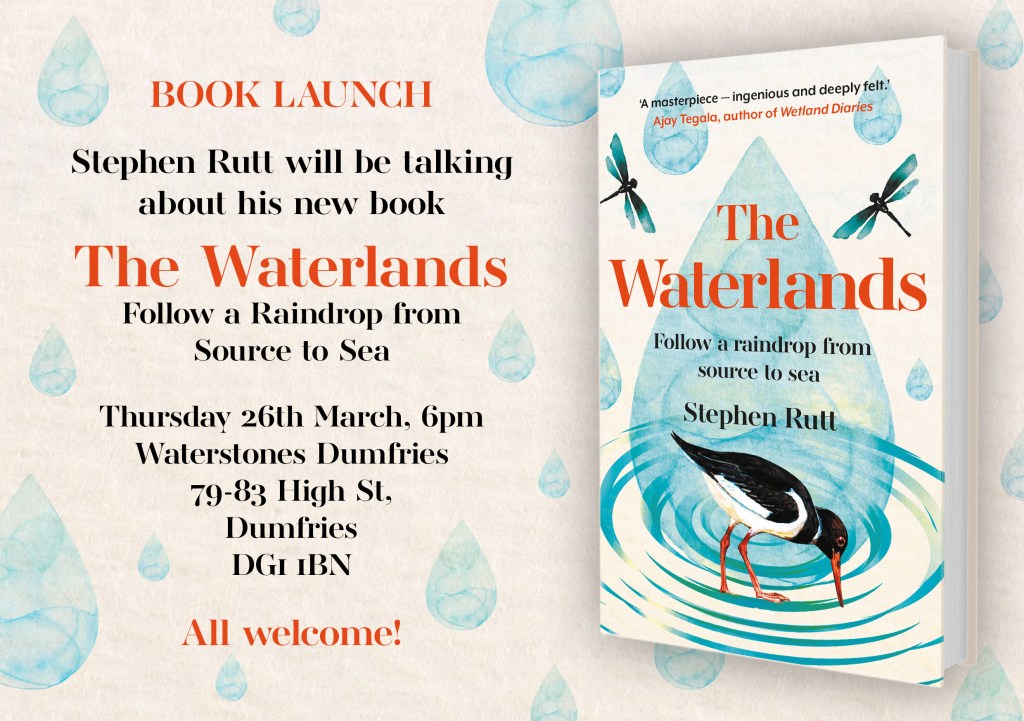
And now it’s June, and I should be in a bookshop somewhere in Scotland reading from the newly published paperback edition of The Seafarers. Only I’m in England, still locked down, but with the benefit of a garden and a rose bush and a pile of books to prop my phone up on…
If you wish to buy a copy of the paperback, here’s a link to Mainstreet Trading, an Independent in the Borders, or Fox Lane Books, a Yorkshire Independent.
So my Scottish events this April have been cancelled – and in the absence of a miracle, it’s safe to assume that my Suffolk event will be too – and I feel really gutted about this. Giving readings and answering questions is something I greatly enjoy. So while in self-isolation, beating the boundaries of my small flat and trying to keep Morag the cat at the appropriate self-distancing distance, I recorded some passages of the book on my phone, to make up for those cancelled events. I hope you enjoy them. To make it more like an event, if you have any questions, try tweeting me @steverutt, leaving a comment or by using the contact form.
And because no event is complete without me trying to flog a book…
“Eagles? When I saw my first eagle,” Cate says, “it was on the single-track road to Ullapool. We startled it as we drove around the corner and it flew off, wings as wide as the road. And my memories of it” – Cate’s eyes widen – “are as if it happened in slow motion.”
Cate is right. Eagles, for those of us who lack the fortune to see them regularly, seem to have this quality. Of crystal clarity and a slowing down of time. It becomes all about the moment.
***
The sky is a conjurer. Its sleight of hand is to reveal and hide in plain sight.
“I’m sure that was an eagle,” I say. Miranda pulls the car over by the side of the road, twenty minutes’ drive out of Stornoway. A scattering of roadside houses and heathery bog to our right. To our left a loch and a smooth brown moor, suede-like, rolling to the black hills of south Lewis.
The seconds stretch by. I become increasingly frantic. And then it pops out beyond the roof of a house.
A big bird, black against the bright sky, in a lazy-flapping flight. A buzzard is harassing it, diving at a wing bigger than the whole of itself.
A young white-tailed eagle. It drifts for thirty seconds, unbothered by the buzzard before it vanishes over the fold in the moor that hides the rest of the island from us.
And then we turn around.
It’s sometimes impossible to say what first draws your eye. It must have been the slow movement, of a dark shape against those dark hills. Or of the sun catching on the soft-edges of feathers, ringing slow wings with a halo of light, throwing the bird into relief against the landscape as it flies directly towards us. An adult white-tailed eagle. Pale head, white-tail, body the colour of the island of Lewis.
It carries on coming towards us. A wingspan of 7 foot is the salient detail but it is not the whole story. It is the details that the angle throws up that surprise me more. It is the depth. The breast and legs that give it a primordial bulk, that you don’t see when they are high in the sky.
And it carries on coming towards us until it gains height, gliding, disappearing over the moorland fold, a threshold between our world and its own. And in that moment I realise I can say nothing at all. My thoughts trumped by thrill. My language dissolved.
***
The wind rakes the island like a reckoning.
Overnight Harris has been painted with snow and now it is alternating sunshine and hail. There’s not much to do this February day other than drive and walk and sit and stare.
At Luskentyre the sand is as soft and powdery as fresh snowfall. We watch waves roll in past Taransay and to the north, the clouds scud over white peaks reflected on wet beach, and the hills to the south turn black as the snow rolls in. We invent new gauges for visibility. We decide it’s ok when the distant headland reappears, even if the hilltops are still shrouded, the sea’s horizon still smudged with blizzards.
We drive through the landscape to the lochanscape, then the rockscape, then the lunarscape. Along the south coast of Harris the valley walls have a lace-curtain of snow and ice. A raven reverberates around them, the sound like a distant rock movement. It draws my eyes to another black speck, a winged glitch in vision. And I know what it is immediately. I can tell by the way my breath-catches in my throat and the way that my fingers tremble on the focus wheel of my binoculars.
One glitch becomes two. A pair of golden eagles rise above the valley walls and now the raven is nowhere to be seen. They drift against the snow-cloud grey sky. The smaller male folds his wings in, drops briefly, unfurls them and rises up again. The female repeats. They undulate through the sky until they too have drifted over the ridgeline. And then the hail begins again and the sky closes in.





 Stephen Rutt